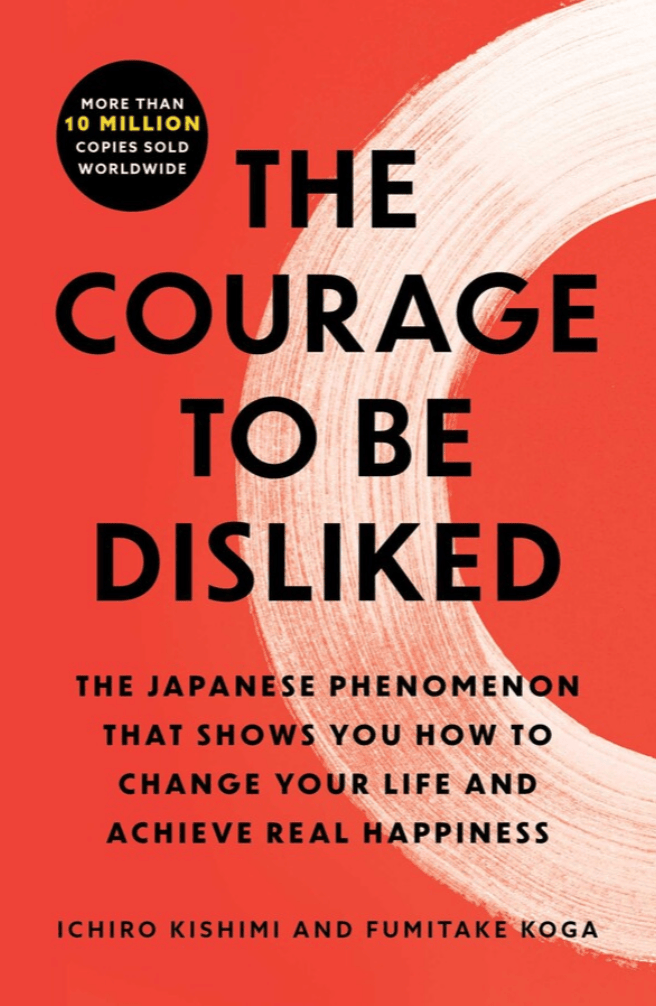
Some books comfort you. Some books give you answers.
And some books feel like a cold shower.
The Courage to Be Disliked was a cold shower for me.
Built around Adlerian psychology and written as a dialogue between a philosopher and a young man, this book repeatedly asks us to question something we usually take for granted: How much of the life I am living today am I attributing to my past, my circumstances, other people, or the things I believe I lack?
One of its most provocative ideas is that our past does not have to determine our present.
That doesn’t mean that our experiences didn’t happen or that painful experiences don’t matter. What challenged me was the idea that we can sometimes continue using the past to explain why change isn’t possible today.
Because change is scary.
Sometimes the life we know — even when we don’t particularly like it — feels safer than the life we haven’t lived yet.
And that leads to one of my biggest takeaways from the book: we can become our own obstacle.
We tell ourselves that we aren’t confident enough, educated enough, attractive enough, talented enough, young enough, experienced enough. We take what we perceive as our shortcomings and sometimes build an entire explanation of our lives around them.
The book invites us to look at ourselves with much more radical honesty.
What is objectively true? What is simply my interpretation?
And what story have I been repeating for so long that I have started treating it as a fact?
Another idea that stayed with me is Adler’s rejection of life as competition.
When we constantly compare ourselves with others, life becomes a ranking system. Someone else’s success can begin to feel like evidence of our inadequacy. There is always someone ahead of us, someone achieving more, earning more, looking better, moving faster.
What an exhausting way to live.
The alternative offered by the book is a sense of community and contribution: other human beings don’t have to be my competitors. Someone else’s success does not take success away from me. There is room for all of us.
But perhaps the deepest message I took from this book is about agency.
We don’t choose everything that happens to us.
Life can give us circumstances we never asked for. People can hurt us. Families, cultures and environments shape us. Some realities are outside our control.
But eventually the question has to move from:
Why am I like this?
to:
Given that this is where I am, what am I going to do now?
For me, that is not blame.
It is responsibility.
And strangely enough, there is freedom in it.
Because if I have participated in putting myself down, I can also participate in pulling myself up.
If I have been participating in the construction of my own prison, then I also possess some of the tools required to dismantle it.
That is what The Courage to Be Disliked gave me: not permission to deny my past, but permission to stop allowing it to have the final word.
It asks for radical honesty, but also deep acceptance.
Acceptance of where I am, and of what I cannot change.
Acceptance that other people’s opinions belong to them.
Acceptance that I don’t have to win against anyone else in order to live a meaningful life.
And, perhaps most uncomfortably, acceptance that what I do next is increasingly in my hands.
I don’t agree unquestioningly with every idea in this book. Some of its claims about the past and human behaviour deserve more nuance than they sometimes receive. Human beings are shaped by complicated psychological, social and cultural realities.
But perhaps I don’t need to agree with a book completely for it to do something important to me.
Sometimes I need a book to challenge the story I have been telling myself.
This one did.
And the question I’m taking with me is no longer only:
What happened to me that made me who I am?
It is also:
Who am I choosing to practice becoming now?


Leave a Reply